
Many traders looking to get funded through FTMO often ask the same question:
Should I choose the 1-Step Challenge or the traditional 2-Step Challenge?
At first glance, the 1-Step account looks easier because there is only one phase to pass. However, when you examine the rules closely, the reality is very different.
In this blog, we will break down the differences between both account types, explain the hidden risks many traders overlook, and show why Acceage recommends the 2-Step challenge for long-term consistency and account growth.
⸻
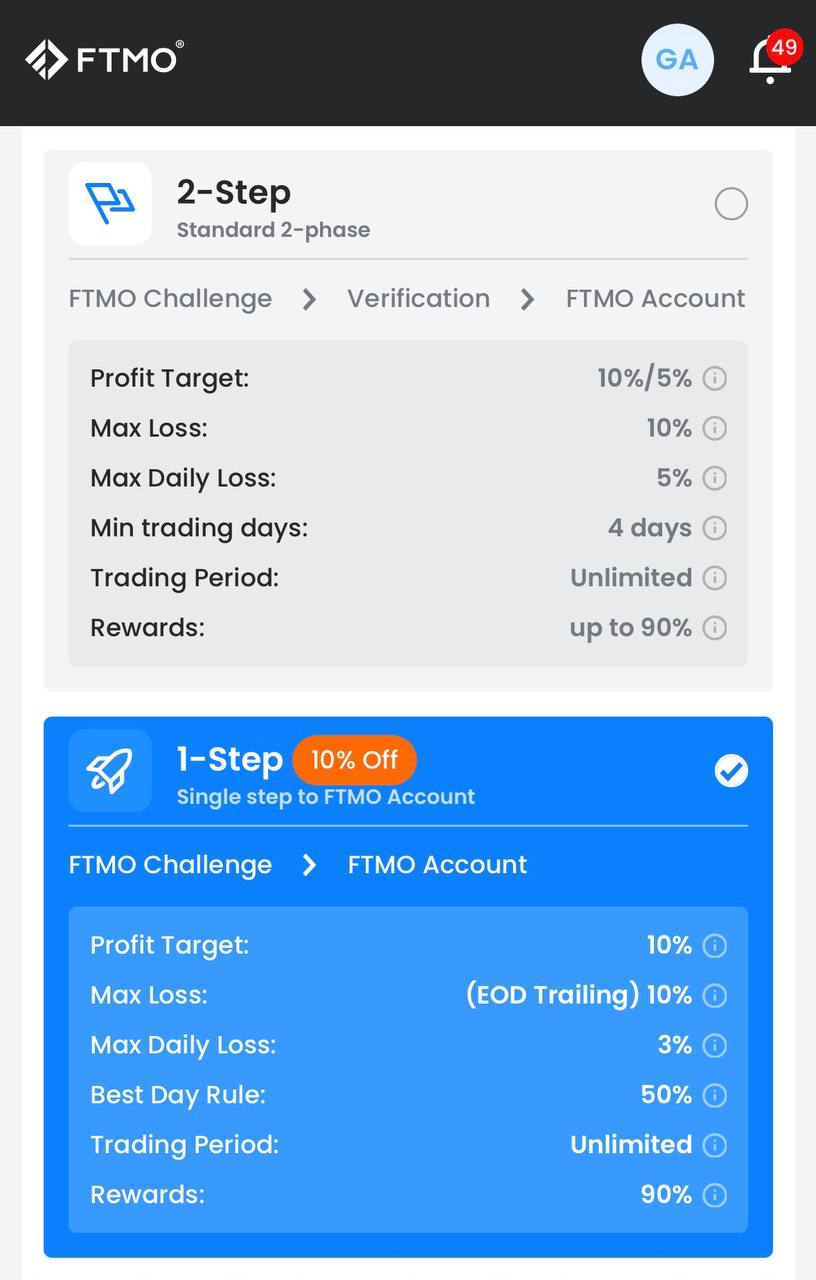
FTMO 2-Step Challenge (Standard)
The Standard 2-Step model is FTMO’s traditional funding process.
Rules Overview
Profit Target: 10% in Phase 1 and 5% in Verification
Max Daily Loss: 5%
Max Overall Loss: 10%
Minimum Trading Days: 4
Trading Period: Unlimited
Profit Split: Up to 90%
How It Works
You first pass the FTMO Challenge by reaching the 10% target while respecting the risk rules. After that, you move into the Verification phase, where the target drops to only 5%.
Once both phases are completed successfully, you receive the funded FTMO account.
⸻
FTMO 1-Step Challenge
The 1-Step account is designed to provide faster access to funding.
Rules Overview
Profit Target: 10%
Max Daily Loss: 3%
Max Overall Loss: 10% (Trailing End-of-Day)
Best Day Rule: 50%
Trading Period: Unlimited
Profit Split: 90%
At first, many traders assume this is the easier option because there is no Verification phase. However, the hidden restrictions make it significantly more difficult for many trading styles.
⸻
The Biggest Differences Between 1-Step and 2-Step
1. Daily Drawdown Rules
The Standard 2-Step account allows a 5% daily loss.
The 1-Step account only allows 3%.
Example on a $200,000 Account
2-Step Daily Drawdown: $10,000
1-Step Daily Drawdown: $6,000
That is a massive difference.
For traders using higher lot sizes, automated trading systems, or trading during volatile sessions, the 1-Step account leaves much less room for normal market fluctuations.
⸻
2. Trailing Drawdown Risk
This is one of the most important differences.
The 1-Step account uses a trailing drawdown system, meaning your loss limit can move upward as your account grows.
Example
Starting Balance: $200,000
Account Grows to: $208,000
Your allowable drawdown may move higher as the balance increases.
This means traders can lose accounts even after being in profit if the account retraces too much.
The 2-Step model does not apply this same trailing pressure, making long-term account management much more flexible.
⸻
3. The Best Day Rule
The 1-Step account includes a “Best Day Rule.”
This means:
No single trading day can represent more than 50% of your total profits.
Example
If your total profit is $20,000:
One trading day cannot exceed $10,000 profit.
This rule can become a major issue for:
News traders
High volatility traders
Aggressive scalpers
Algorithmic systems that capitalize on strong market moves
The Standard 2-Step account does not have this restriction.
⸻
Why Acceage Recommends the 2-Step Challenge
At Acceage, we strongly recommend the FTMO 2-Step Challenge for most traders, especially those looking for long-term consistency and account scalability.
Over the years, we have worked with many funded accounts and different prop firm models, and one thing became very clear:
More flexibility usually leads to better long-term survival and profitability.
The 2-Step model gives traders:
More room for market fluctuations
Better risk management flexibility
Higher daily drawdown allowance
No trailing drawdown pressure
Better conditions for automated trading systems
A more stable environment for consistent growth
While the 1-Step account may look attractive because it skips Verification, many traders underestimate how restrictive the rules actually are.
⸻
How Acceage Helps Traders Pass Prop Firm Challenges
Many traders struggle with prop firm challenges because of:
Emotional trading
Overleveraging
Poor risk management
Inconsistent strategies
Violating drawdown rules
This is where Acceage helps clients simplify the process.
Acceage Services Include:
Helping traders pass prop firm evaluations
Auto-trading support
Risk management strategies
Funded account management
Consistent algorithm-based trading approaches
Our focus is not only on passing challenges but also on maintaining account stability after funding.
Many traders can achieve profits temporarily, but long-term consistency is what truly matters in prop firm trading.
⸻
Why Risk Management Matters More Than Speed
A large number of traders fail prop firm challenges not because they cannot trade, but because they:
Trade too aggressively
Ignore drawdown limits
Chase fast profits
Use poor position sizing
The best prop firm traders focus on:
Capital preservation
Consistency
Controlled growth
Long-term scalability
That is why Acceage generally prefers the 2-Step model over the 1-Step model.
The slightly longer process often creates a much stronger and more sustainable funded trading environment.
⸻
Final Thoughts
The FTMO 1-Step challenge may seem easier because it removes the second phase, but the tighter restrictions create additional pressure that many traders underestimate.
For traders focused on consistency, scalability, and safer long-term trading, the traditional 2-Step account remains the stronger option in many cases.
Especially for larger funded accounts such as $100,000 or $200,000, the additional flexibility of the 2-Step model can make a major difference in account survival and long-term profitability.
If your goal is to build a funded trading account the right way, focusing on disciplined risk management and long-term consistency is often far more important than trying to pass as quickly as possible.
Learn more about Acceage services here:
Acceage Prop Firm Services